Why Do Yoshitomo Nara’s Kids Look So Angry?
The story behind Yoshitomo Nara’s big-eyed children. From a childhood in northern Japan and a lifelong obsession with music to Germany, protest art and one of the most recognisable faces in contemporary art.
By Maria Pri
09 min read
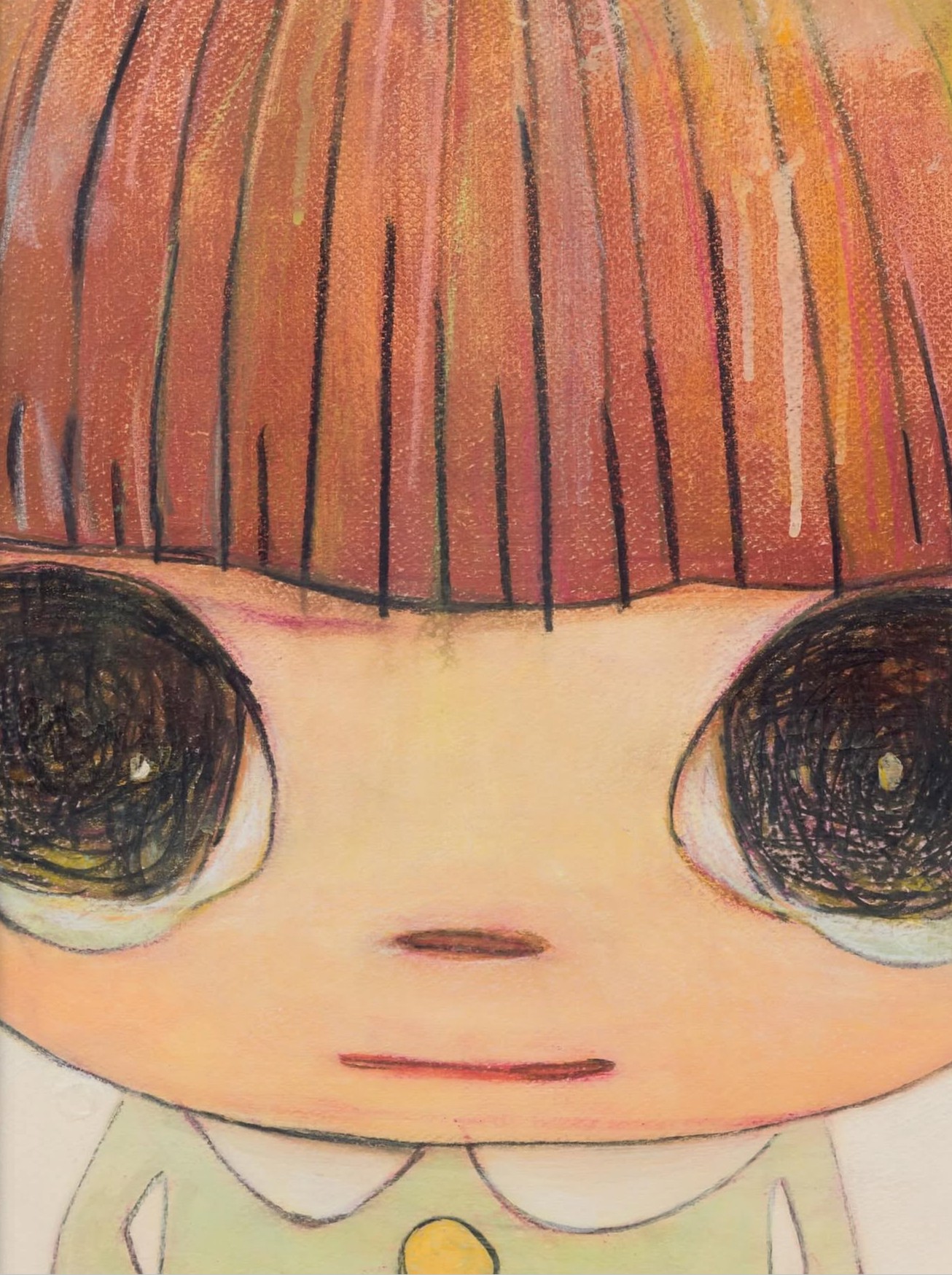
© Yoshitomo Nara
Before the $25 Million Painting, Yoshitomo Nara Was a Kid Listening to the Radio
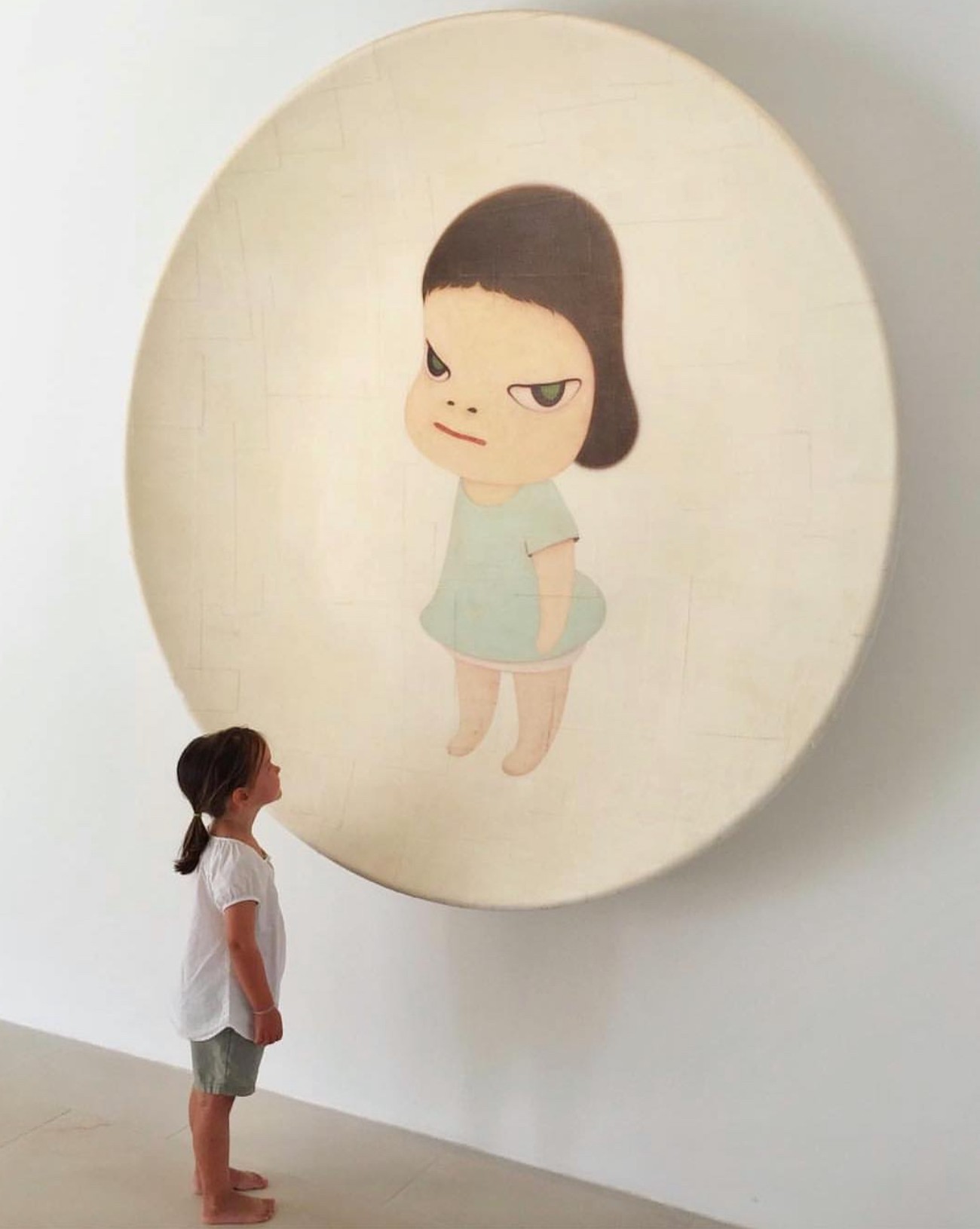
You’ve probably seen these children with huge heads before even if you don’t know who Yoshitomo Nara is.
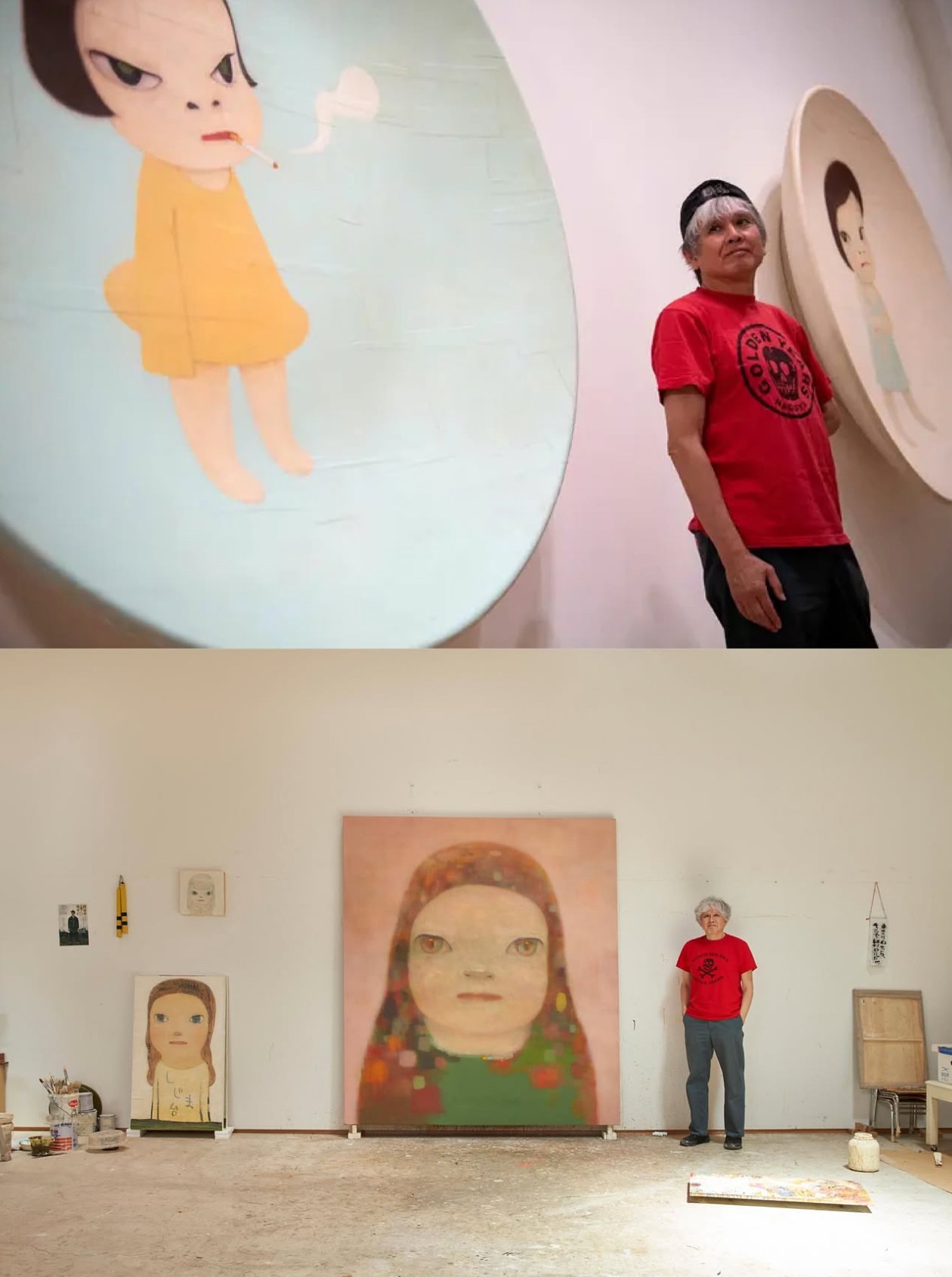
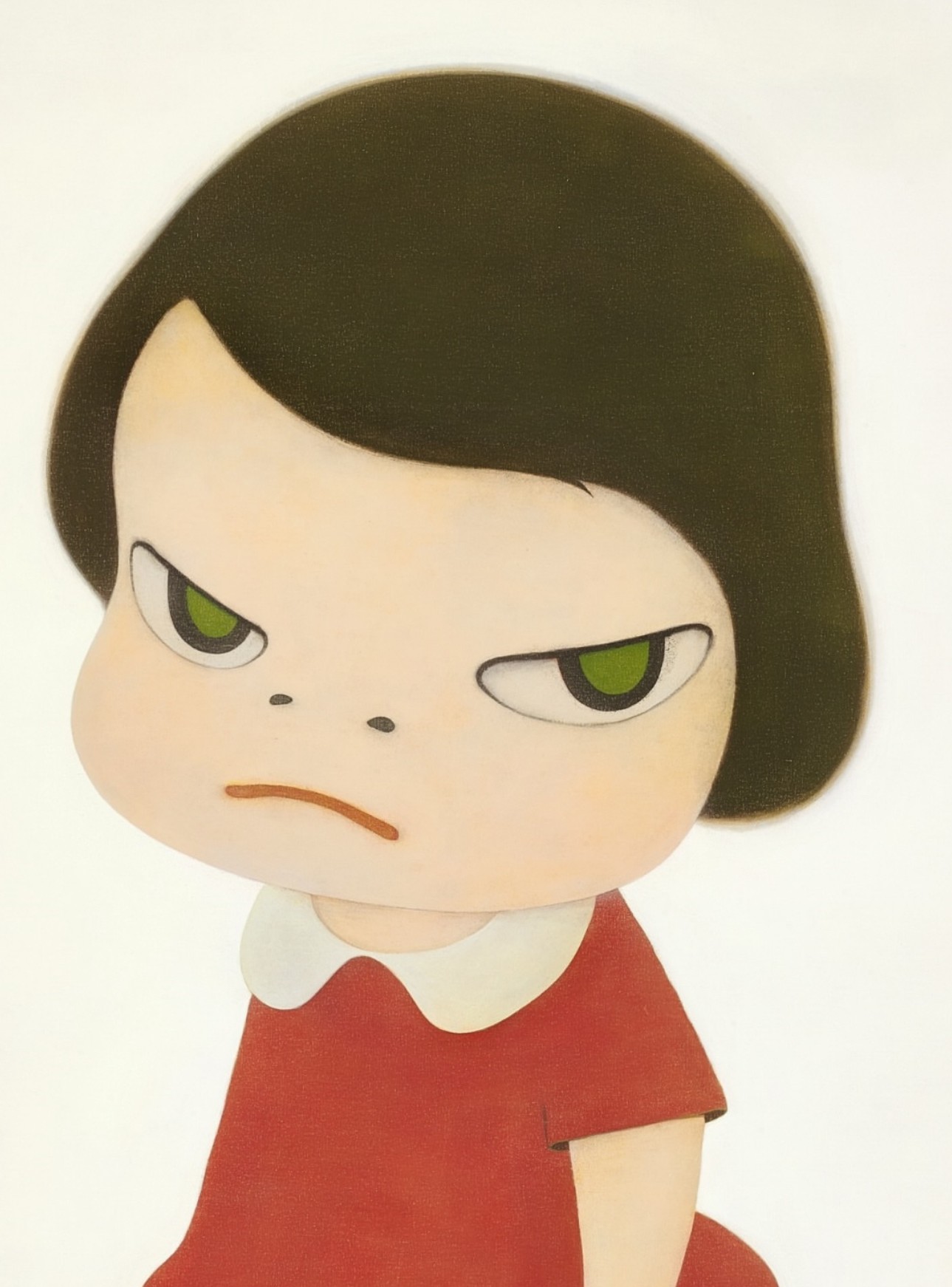
Big heads, tiny bodies, huge eyes and that permanently annoyed expression. Sometimes they’re holding a knife. Sometimes smoking a cigarette. Sometimes they’re just standing there looking like they really don’t want to talk to you.
They look like children, but they never really behave like the sweet children we’re used to seeing in art.
That is basically the world of Yoshitomo Nara.
Nara has been painting these strange childlike figures for more than three decades, and today they are everywhere. One of his paintings, Knife Behind Back, sold at Sotheby’s Hong Kong in 2019 for HK$196 million - around US$24.9 million at the time, after six bidders competed for it.
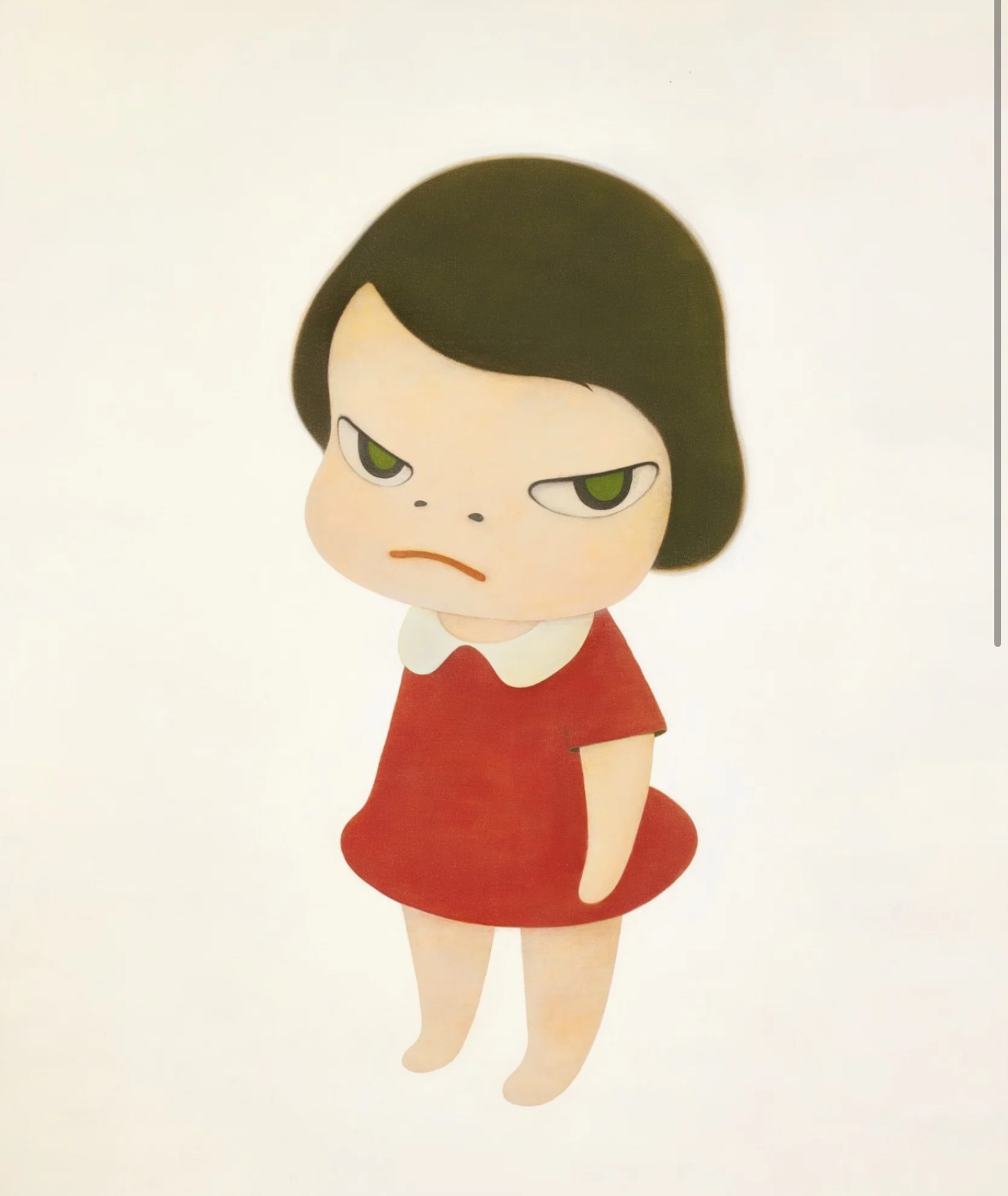
But his story begins somewhere much quieter.
Aomori, apple orchards and a lot of time alone
Yoshitomo Nara was born on December 5, 1959, in Hirosaki, in Aomori Prefecture in northern Japan. He grew up in a semi-rural area surrounded by fields, animals and apple orchards. Both of his parents worked, so he was what we would now call a latchkey kid: he regularly came home from school without an adult there.
This part of his biography is important because people love turning it into the obvious artist story: lonely child grows up and paints lonely children.
Nara himself has basically said it wasn’t that simple.
He spent a lot of time alone, yes, but he doesn’t remember his childhood as particularly unhappy. He has said he was good at entertaining himself, had animals around him and developed a strong imagination. To an adult, a child sitting alone might look lonely. That doesn’t necessarily mean the child feels lonely.
He drew constantly too. Anything that could be drawn on was useful. The Guggenheim’s biography describes him drawing and making cartoons on whatever paper he could find at home.
But weirdly enough, art still wasn’t the biggest thing in his life.
Music was.
Before art, there was music
Around elementary-school age, Nara discovered that his radio could pick up FEN, the Far East Network, which broadcast for American military personnel stationed in Japan. The signal came from the area around the U.S. air base at Misawa, roughly 100 kilometres from his home.
He couldn’t really understand the English. But he listened anyway.
On the radio he heard pop, country, soul, rock, blues, psychedelic music and American folk songs. He was growing up during the Vietnam War, so some of the music arriving through those broadcasts also carried the language of protest, civil rights and anti-war movements.
And because he couldn’t understand all the words, he had to make sense of the songs in another way.
Through the sound. Through the feeling. And through the album covers.
Nara has said that record sleeves were some of the first visual art he really encountered. His childhood favourites included artists such as The Beatles and The Rolling Stones; as a teenager he became especially attached to Neil Young, and his tastes eventually spread across folk, rock, blues, punk and new wave.
By his teens, he was spending so much time in a local record shop that the owner eventually gave him a part-time job there. Nara later wrote that at that point he was basically a teenage music obsessive and had no idea he would end up becoming an artist.
Which is probably why looking at his work only through anime or kawaii culture feels a little lazy.
Yes, the children have huge heads and cartoon-like proportions. But there is also Bob Dylan, punk, anti-war folk music, German painting, children’s books, his own memories and about fifty years of record collecting in there.
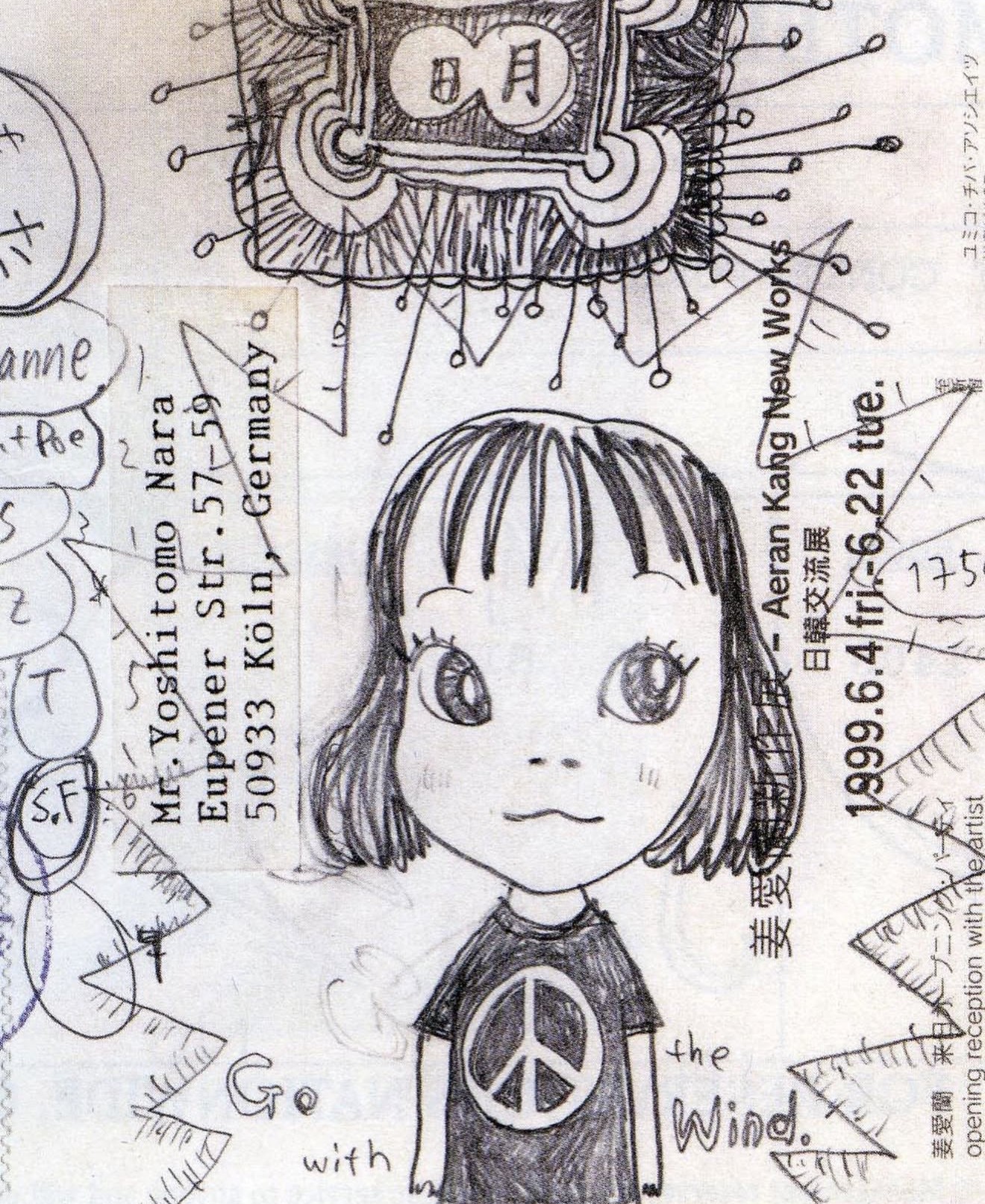
Nara himself has repeatedly said that his real roots are in his own childhood and experiences rather than simply contemporary pop culture.
He wasn’t even sure he wanted to be an artist
After high school, Nara eventually entered Musashino Art University in Tokyo in 1979. However, he didn’t stay there long.
Money was tight, and in 1981 he transferred to Aichi University of the Arts, where tuition was cheaper. He studied oil painting there, completed his bachelor’s degree in 1985 and then finished his master’s in 1987.
And even then, he wasn’t living out some childhood dream of becoming a famous painter.
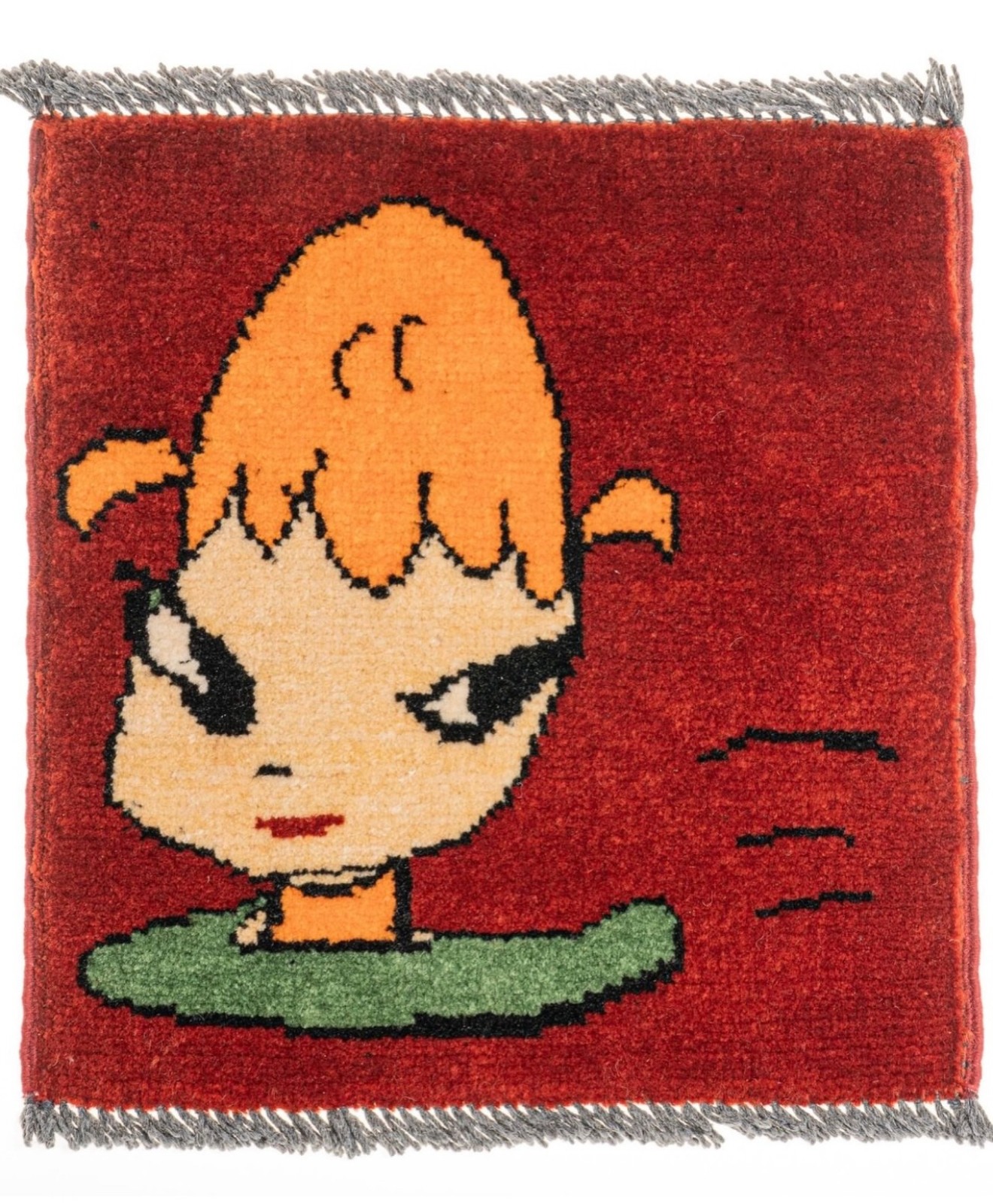
In a later interview, Nara said that although people had told him he was good at drawing as a child, he actually preferred things like reading and playing with his cat or the sheep nearby. Becoming “an artist” was not some grand plan. At some point people just started calling him one.
Then he moved to Germany.
And that is where the Nara we know really started appearing.
Germany basically changed everything
In 1988, Nara moved to Düsseldorf and enrolled at the Kunstakademie Düsseldorf. He would remain in Germany for twelve years, later moving to Cologne in 1994.
He didn’t speak German fluently, so once again he found himself relatively isolated.
And weirdly, that brought him back to childhood.
Nara has explained that at art school in Japan he felt students were often reading the same books, learning the same techniques and studying the same art history. Their work could start feeling like a school assignment.
Germany made him realise that what distinguished one artist from another wasn’t necessarily how much art theory they knew.
It was their life. Their memories. Their background. Where they came from. The things that couldn’t simply be taught to everybody else in the same classroom.
For Nara, that meant going backwards.
He started thinking much more seriously about Aomori, his childhood and the way he had seen the world before becoming an art student. He has said that recovering those childhood sensibilities was what eventually allowed the children in his paintings to appear.
Another important person was the German artist A.R. Penck, whose class Nara joined in 1991.
Penck apparently gave him very simple advice: paint on the canvas as if you were drawing.
That changed his work completely.
Nara began stripping things away. Earlier compositions became simpler. Backgrounds disappeared. Figures became larger and more isolated. That same year he made The Girl with the Knife in Her Hand, one of the paintings that helped establish the direction his work would take from then on.
By the mid-1990s, the formula was becoming unmistakably his.
One figure and a huge head. Very little happening around them. And a face doing most of the work.
Except they’re not really “angry girls”
This is where most descriptions of Nara go slightly wrong.
People call them girls.
Even though, Nara has said he doesn’t necessarily think of them that way.
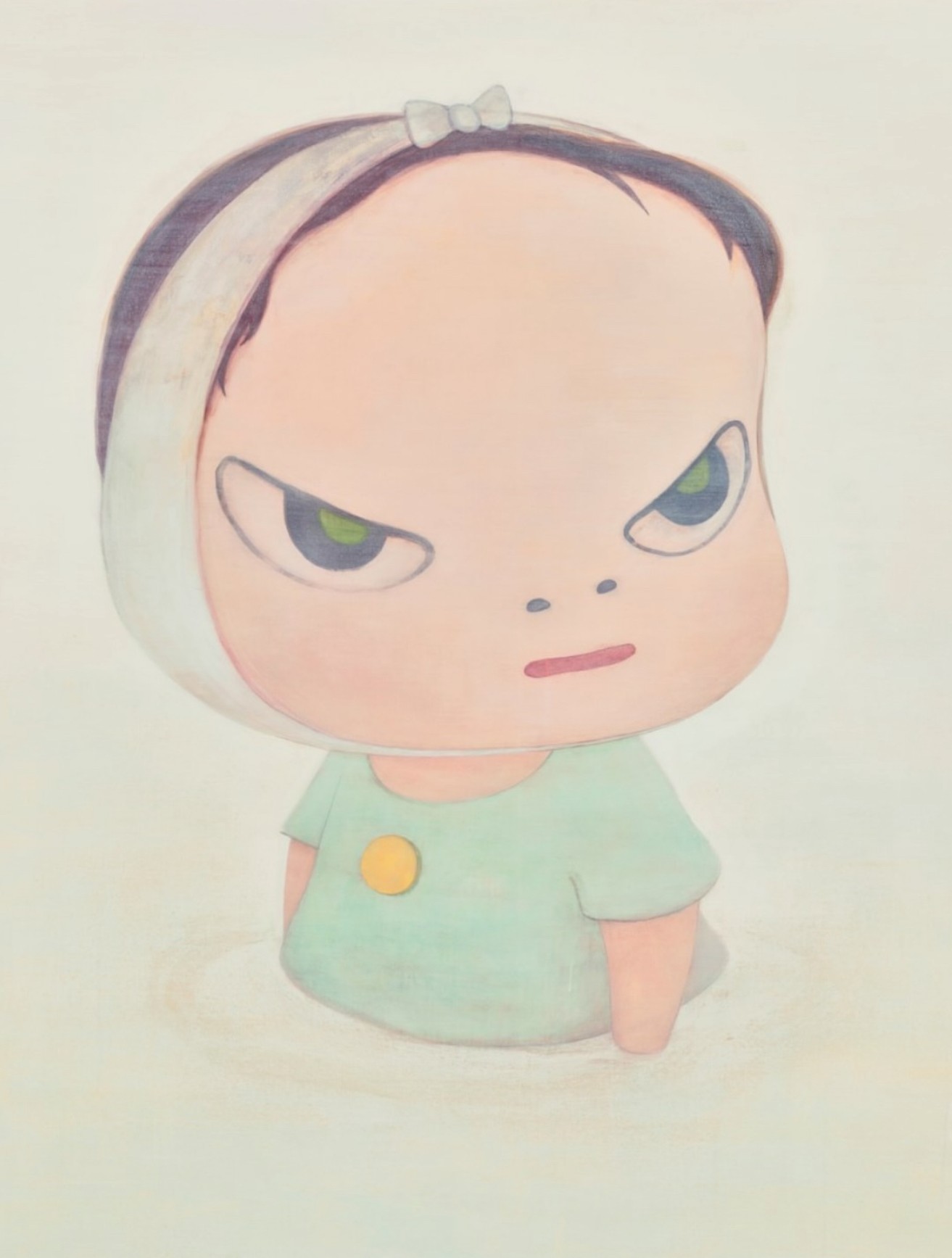
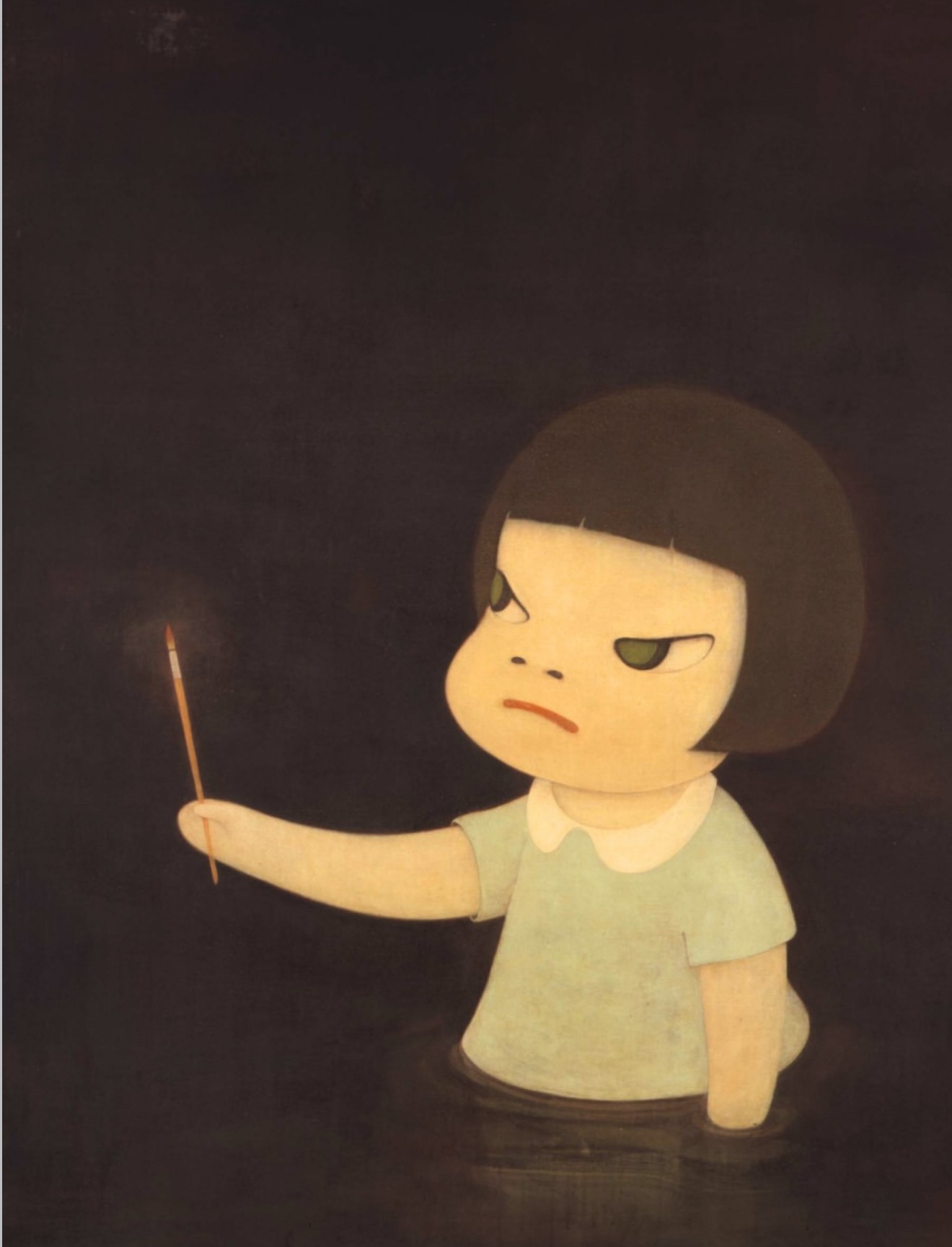
When asked why the subjects of his supposed self-portraits were usually girls, he replied that he wasn’t consciously drawing girls or boys. If he had to categorise them at all, he described them as children with a kind of gender neutrality.
In another interview, though, he also said there may be “a girl’s sensibility” inside him that comes out in the work. So it isn’t quite as simple as saying they are genderless either. Like most things with Nara, he doesn’t seem especially interested in giving the characters a clean category.
He has called the work self-portraiture, but not because the children literally look like him.
They’re closer to internal portraits.
His moods, memories and instincts go into them.
And that also explains why trying to assign one emotion to their faces doesn’t really work.
They can look angry. Or bored. Or lonely. Or completely content to be left alone.
Nara has questioned the assumption that his children are unhappy at all. In a 2000 interview, when asked whether he would ever make a “truly happy child,” he pushed against the idea that the figures needed to fit neatly into happy versus unhappy. For him, childhood was more complicated than that.
He’s slightly obsessed with what happens when we grow up
This might actually be the most interesting part of Nara’s work:
He doesn’t idealise childhood because children are cute. He is interested in childhood because it is temporary.
In a long 2024 interview, Nara talked about how the experiences and sensitivities we have as children can never really be recreated. Later, people start becoming more similar. We consume some of the same culture, learn similar social rules and become much more aware of how we are expected to behave.
He gave one very specific example - In Japan, when children enter junior high school, they might suddenly start using keigo - more formal, polite language.
It’s a tiny thing but to Nara it signals that something has changed. The child is starting to understand hierarchy, social rules and the version of themselves they are expected to present to other people.
And his characters seem to live somewhere around the border before all of that is fully settled. They don’t perform a nice emotion, don’t smile because we expect children to smile. They’re just looking back.
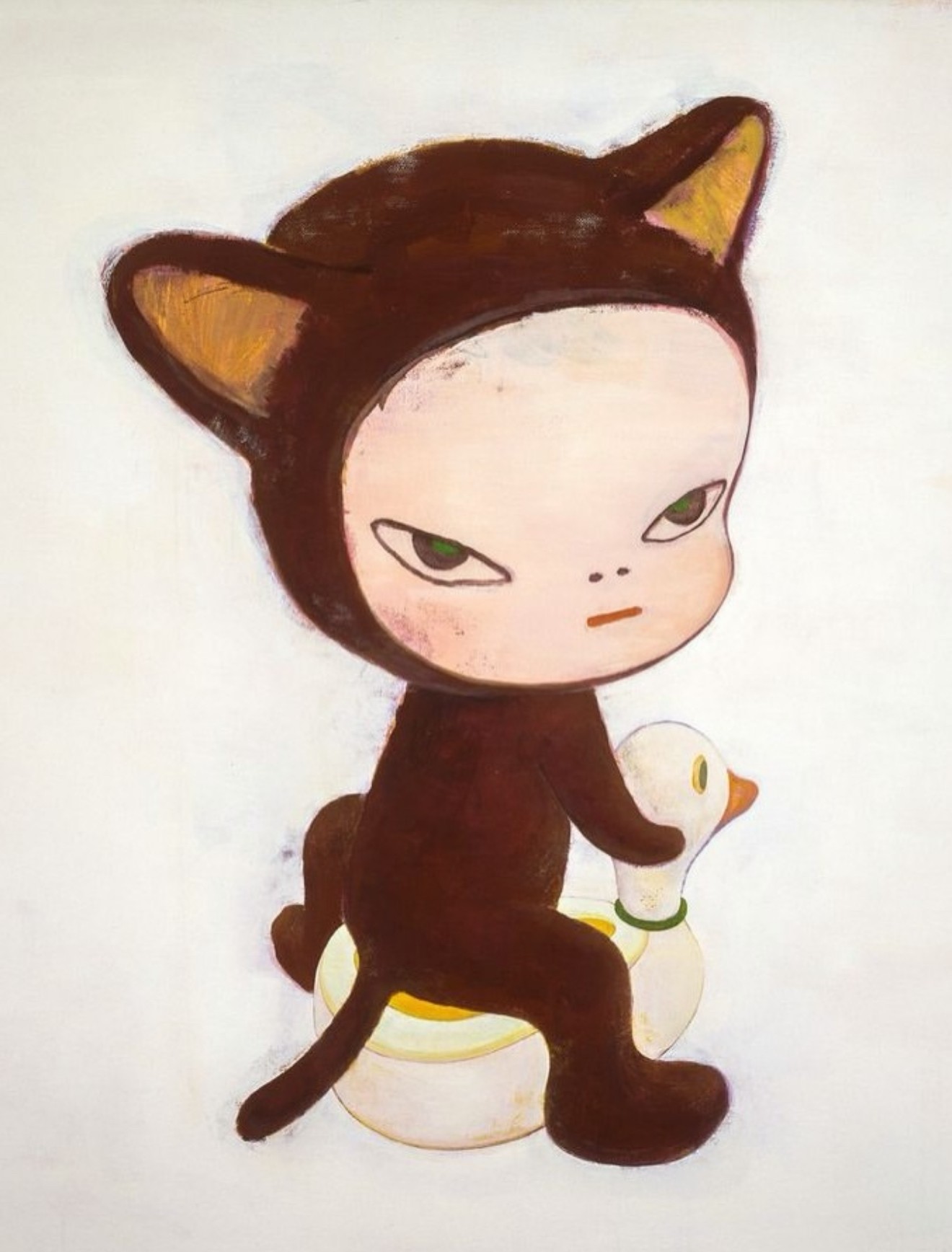
That is probably part of why they still feel slightly unsettling even after you’ve seen them a hundred times.
The houses weren’t random either
Children get all the attention, but houses have been appearing in Nara’s work for decades.
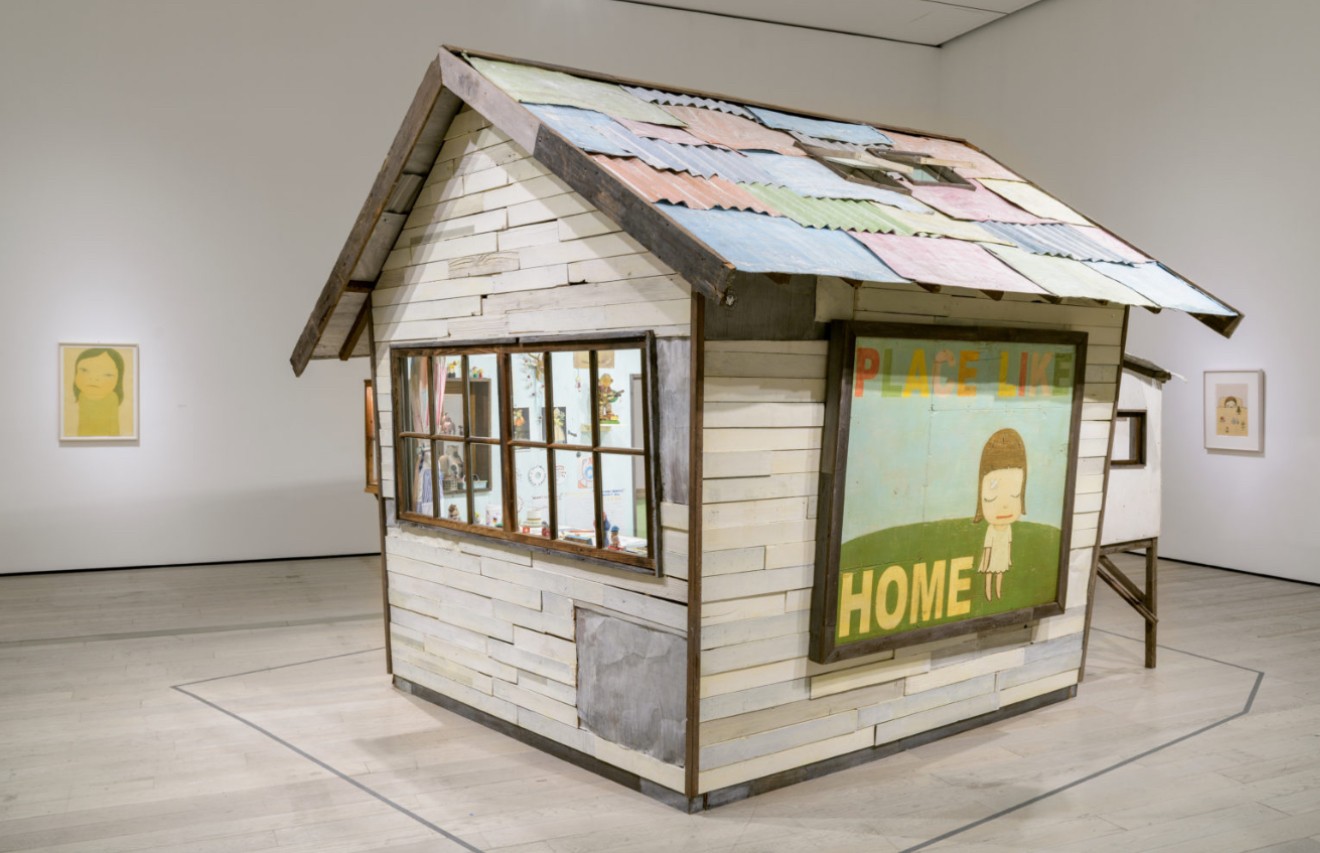
The image comes directly from his own childhood.
He remembers his family home as a single house standing almost by itself in a field. Japan developed rapidly around it, and the real landscape eventually changed, but that solitary house stayed extremely clear in his memory.
His relationship with “home” also changed as he got older.
As a child, home was somewhere safe. As a teenager, it was somewhere he wanted to get away from. Then he spent twelve years in Germany and started looking back at it differently.
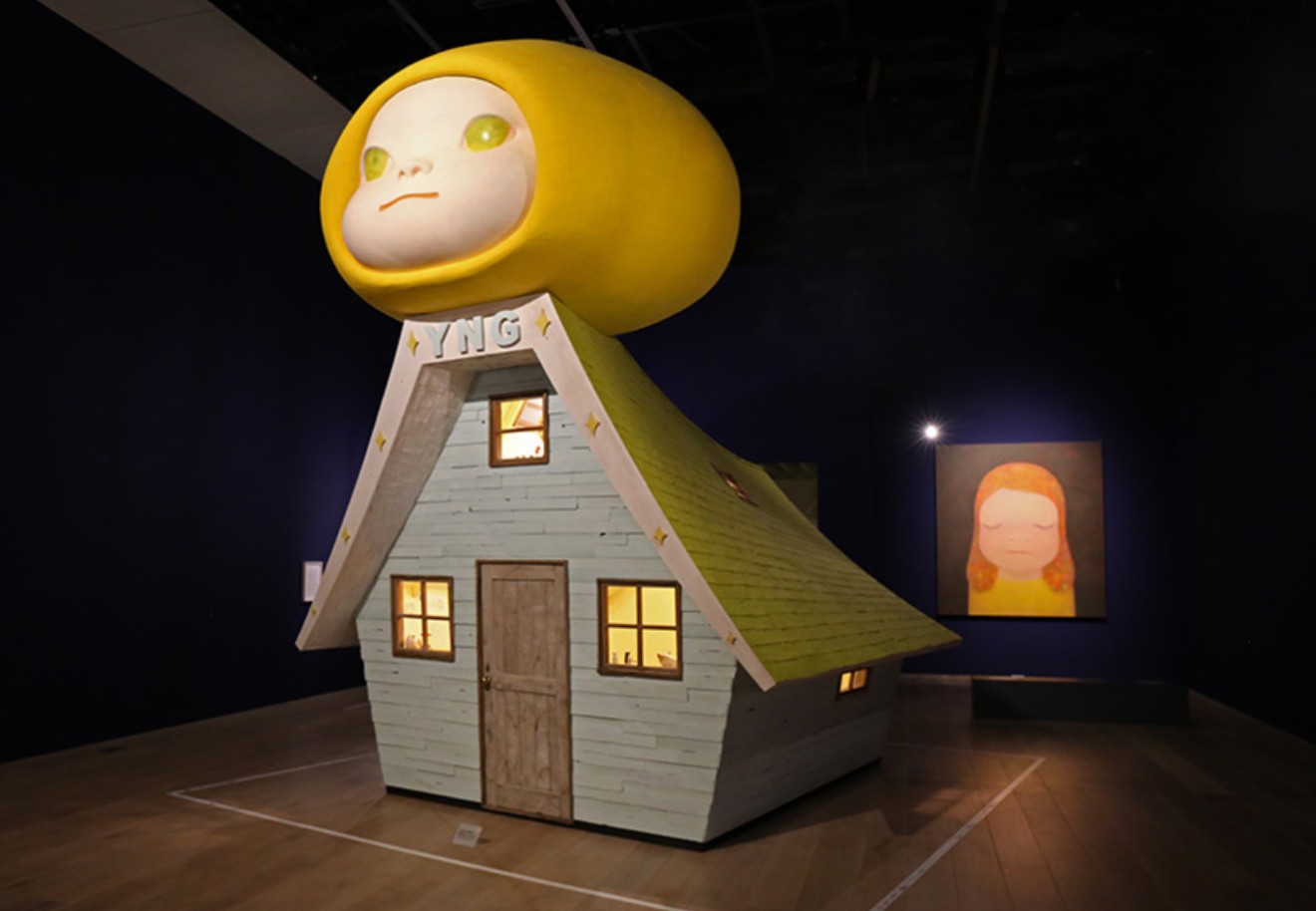
After returning to Japan, houses became physical spaces in his art too.
In the early 2000s he began collaborating with the Osaka design group graf on installations built like small rooms and houses. Later works such as My Drawing Room 2008, Bedroom Included look almost like someone has sliced open a private studio: drawings everywhere, furniture, empty bottles, objects left around and music playing inside.
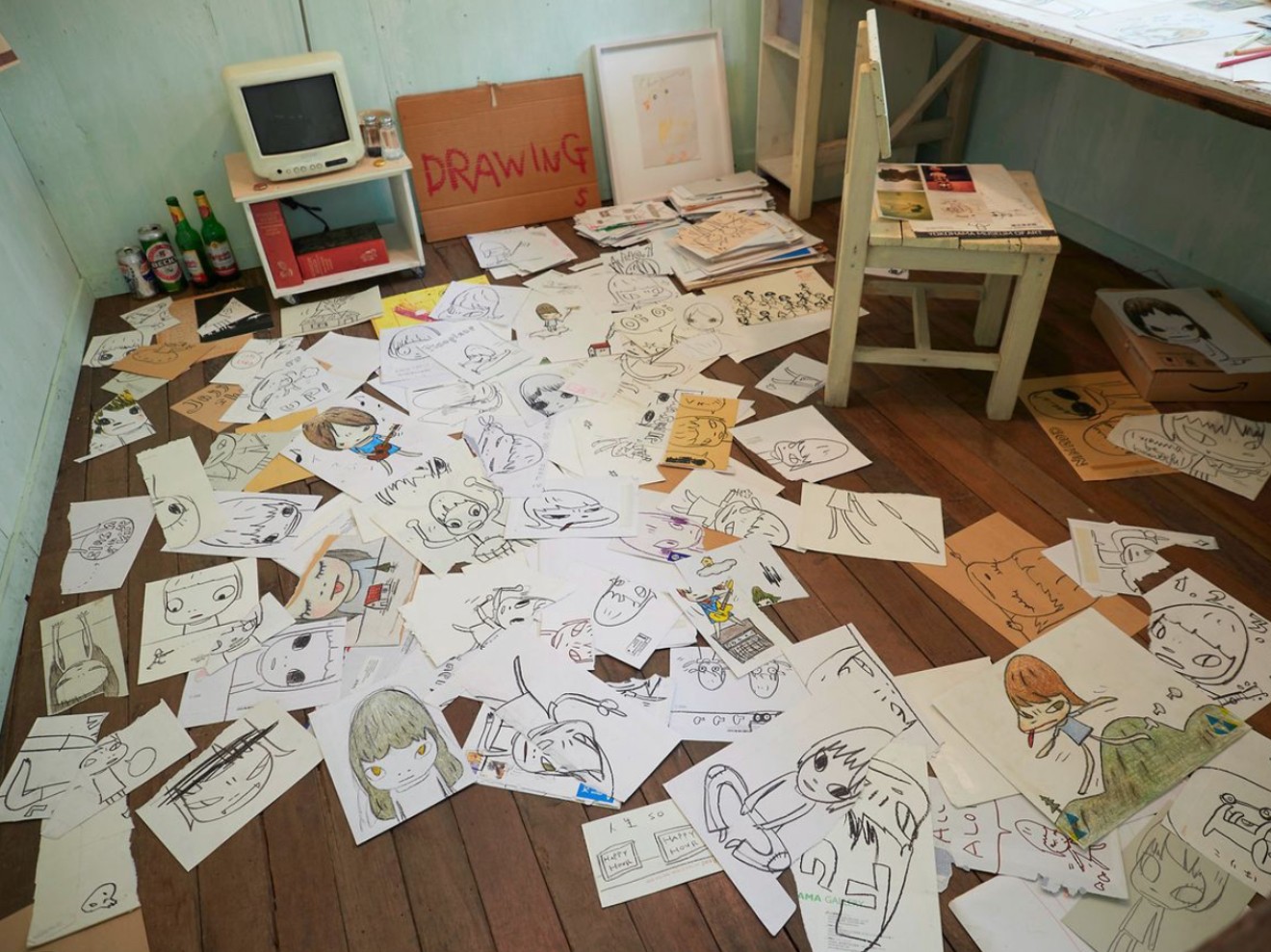
It feels much less like looking at an artwork and much more like looking into somebody’s room while they’re gone.
He came back to Japan for a surprisingly normal reason
Nara returned to Japan in 2000 after twelve years in Germany.
There are lots of dramatic ways you could interpret that - return to his roots, reconnecting with Japan, beginning a new chapter.
Nara’s explanation is much less romantic.
The building containing his studio was going to be demolished. He didn’t feel like searching for another studio in Germany, and he had a major museum exhibition coming up in Japan anyway.
So he went home.
The following year, the Yokohama Museum of Art opened I DON’T MIND, IF YOU FORGET ME., his first major museum solo exhibition in Japan. It brought together paintings, drawings, sculpture and installations and then travelled to several venues around the country.
By this point, Nara’s world was becoming much bigger than paintings of children.
There were dogs, houses, photography, sculptures, rooms, books.
In 1999 he published The Lonesome Puppy, a picture book about an enormous lonely dog. In 2006 he created the monumental white Aomori-ken, often called the Aomori Dog, for the Aomori Museum of Art.
And in 2007 he began experimenting seriously with clay during a residency in Shigaraki, one of Japan’s historic ceramics centres.
That becomes important a few years later.
Then 2011 happened
On March 11, 2011, a massive earthquake struck northeastern Japan, followed by a devastating tsunami and the Fukushima Daiichi nuclear disaster.
The Tōhoku region was deeply familiar to Nara. His mother still lived in Hirosaki, and he regularly travelled through northern Japan.
After the disaster, he found it difficult to paint.
Apart from works made for fundraising, he largely stepped away from painting for a period. He travelled through affected areas, helped deliver supplies with his mother and took part in workshops with students and children displaced by the disaster.
When he started seriously making art again, he first returned through clay.
Working alongside students at his former university in Aichi gave him a different way back into making things. Eventually he returned to painting too, but the faces changed.
The earlier characters could be sharp and confrontational, the later ones often feel quieter.
Their edges soften. Their eyes become much more complex. Some almost seem to be looking through you instead of at you.
Nara himself has said that he sees 2011, more than his return from Germany, as the point after which the atmosphere of his paintings became calmer.
The political side had been there long before Fukushima
It would be wrong, though, to say the earthquake suddenly made Nara political. That part had been there for years.
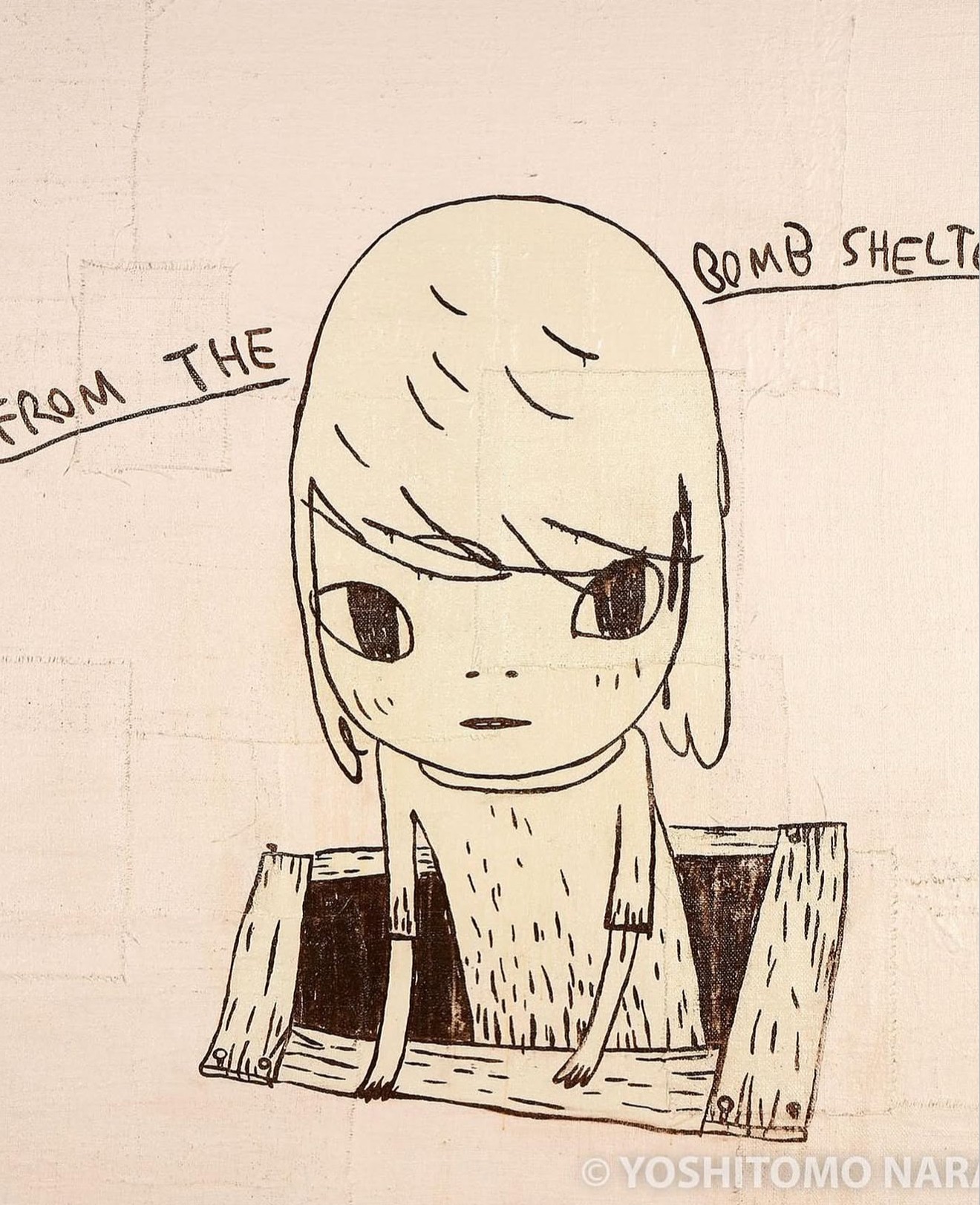
He grew up hearing anti-war folk music during the Vietnam War era, and ideas around peace, war, authority and nuclear weapons appear repeatedly throughout his work.
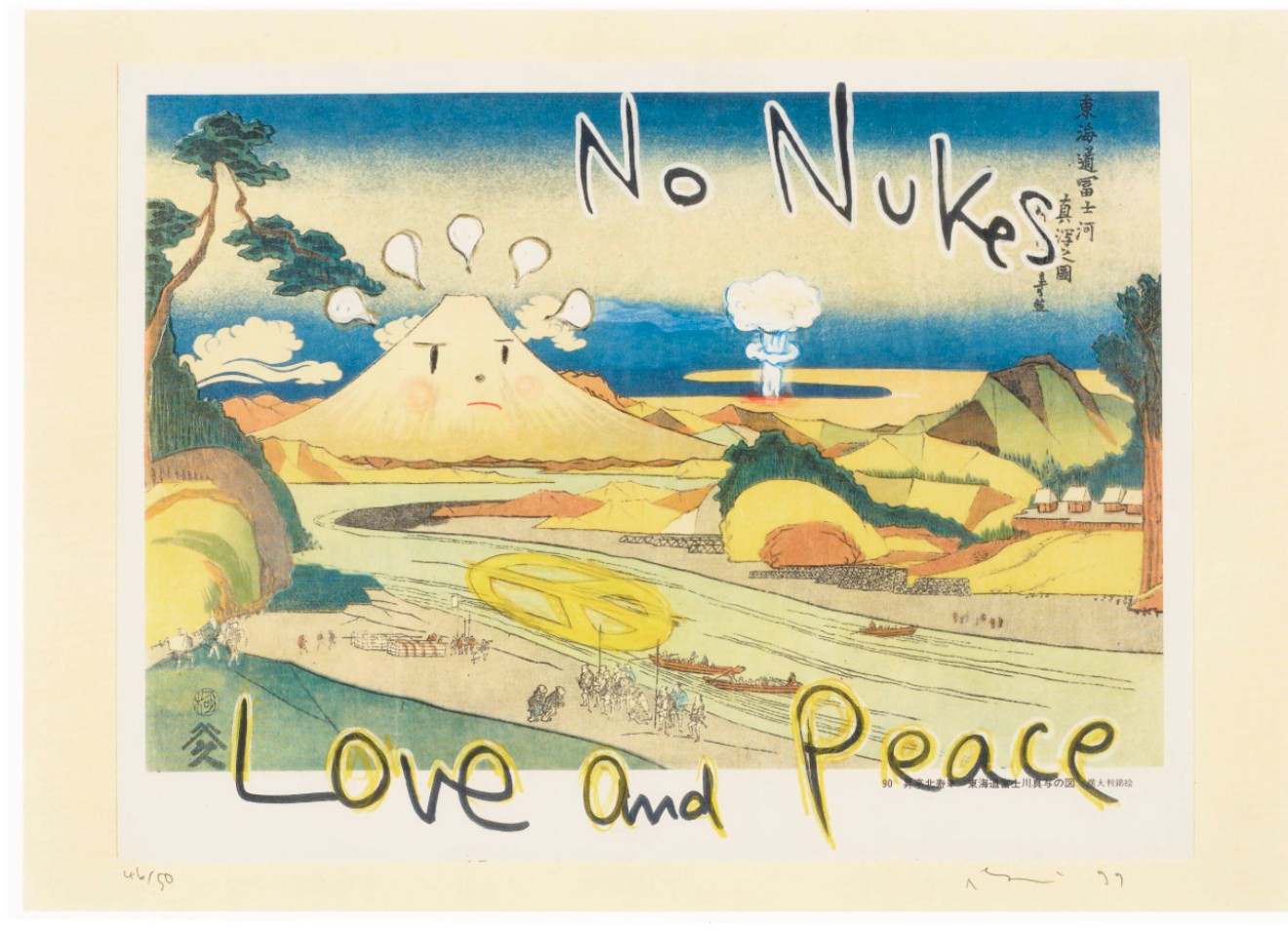
First No Nukes dates from 1959.
In 2002, he travelled to Afghanistan for a magazine project themed around “No War,” photographing ordinary life there. In 2005, the Hiroshima City Museum of Contemporary Art commissioned him to make Missing in Action - Girl Meets Boy, a work created with the atomic bomb in mind.
After Fukushima, images from his work began appearing on anti-nuclear protest signs in Japan with his permission. His No Nukes image from 1998, which had already existed for more than a decade, suddenly had another life outside the museum.
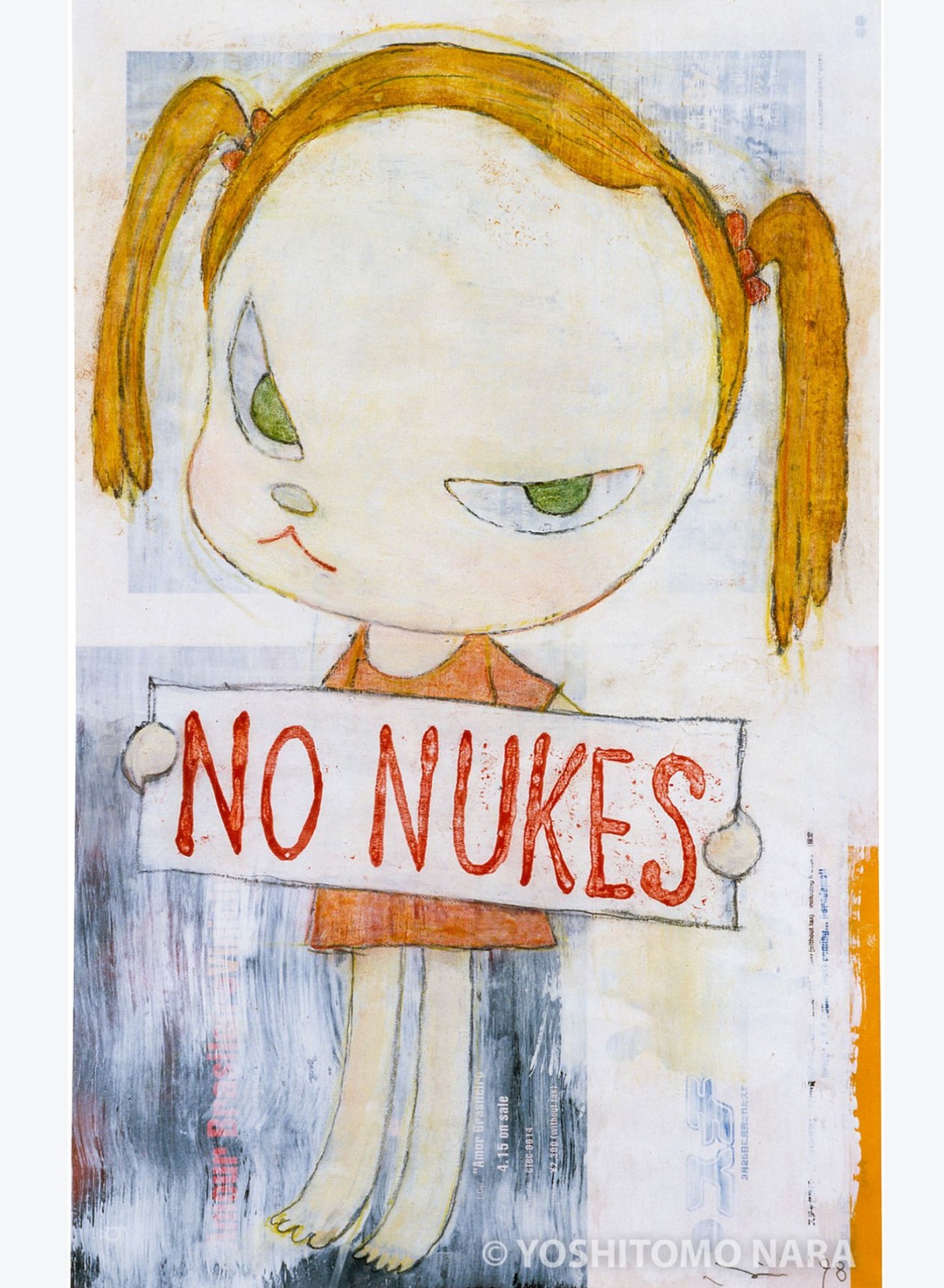
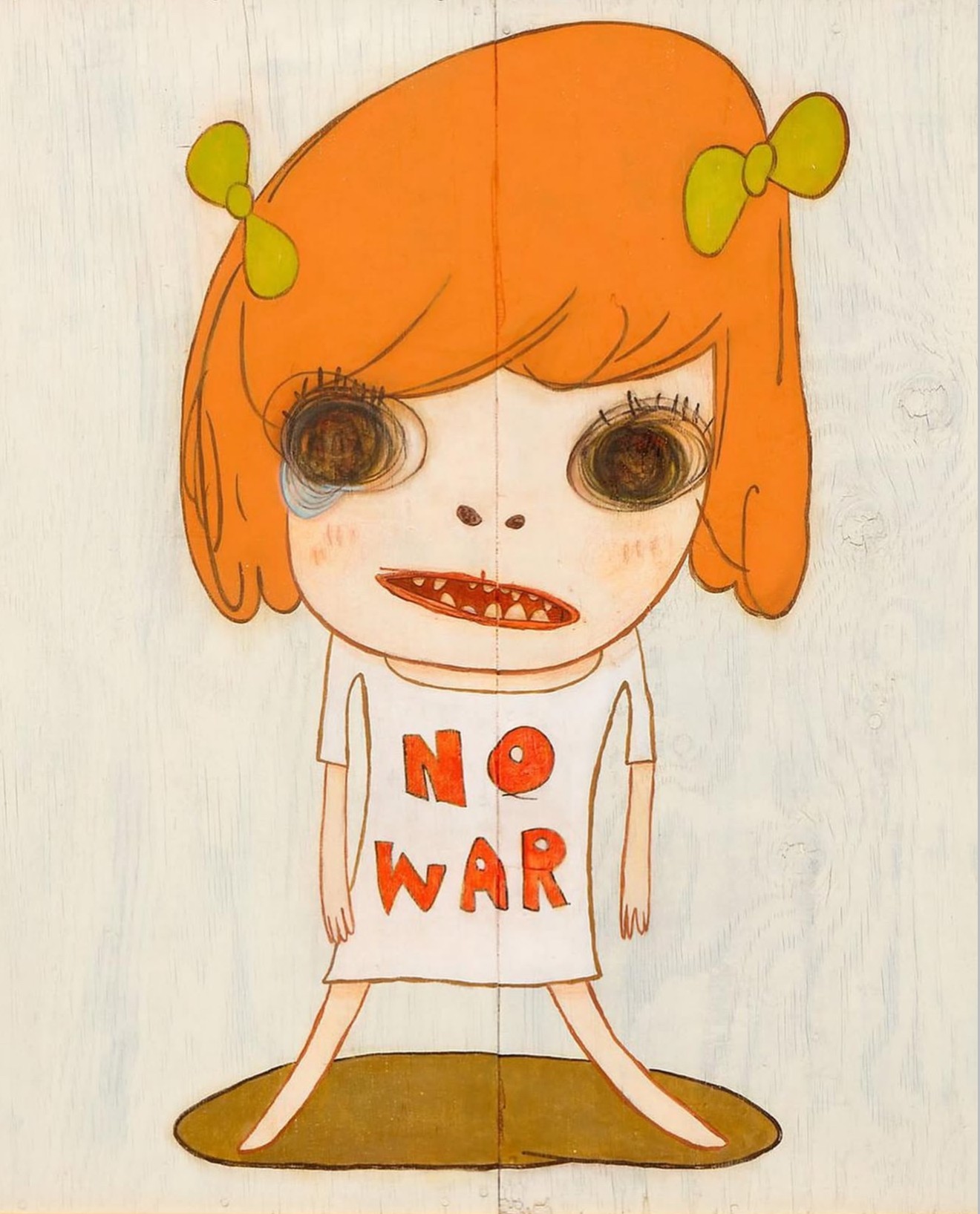
And the slogans continued: No War, Stop the Bombs, peace signs and children holding messages that are extremely direct compared with the ambiguity of their faces. There is something slightly funny and controversial about it. A child with a huge head and cartoon eyes should theoretically be very easy to ignore. However, Nara somehow made her look like the last person in the room who is going to change her mind.
The paintings are actually much less simple than they look
This is another thing Instagram doesn’t really show: A Nara painting can look almost ridiculously straightforward on a screen.
Except it isn’t.
His paintings are constructed through repeated layers of paint, with colours added, altered and sometimes removed until the image is reduced to what he considers essential. The Yoshitomo Nara Foundation describes his painting process as repeatedly layering and erasing colour.
The eyes especially became much more complicated over time.
If you stand close to one of the later paintings, they’re not just black cartoon eyes. There can be tiny shifts of green, blue, yellow, pink and grey sitting inside them.
His drawings work almost in the opposite way.
They can happen very quickly and on almost anything: notebook paper, envelopes, newspapers, pieces of cardboard. Nara has described drawing as something he does almost like breathing or taking notes.
Which explains why the drawings can feel incredibly immediate while the paintings feel almost suspended.
Same world but completely different speed.
Then the art market went insane
Nara had already become internationally known by the late 1990s and 2000s, with museum exhibitions in Japan, Europe and the United States. MoMA now lists more than a hundred of his works in its online collection records.
Then came October 2019.
At Sotheby’s Hong Kong, Knife Behind Back, painted in 2000, went up for auction.
Six bidders wanted it.
Ten minutes later, it had sold for HK$196 million - US$24.9 million - nearly five times Nara’s previous auction record.
The image is almost stupidly simple at first glance. And yet it had taken Nara decades of childhood memories, German art school, punk records, isolation, drawing, painting and figuring out exactly what he could remove from an image without losing its feeling to arrive at something that simple.
The funnier part is Nara’s own attitude toward auction prices. When asked in a 2021 interview how he felt about his works selling for enormous amounts, his answer was basically that no matter how high the price gets, none of that resale money goes to him.
And the kids are still changing
Nara is now in his sixties, but he hasn’t spent the last thirty years reproducing the exact same angry child.
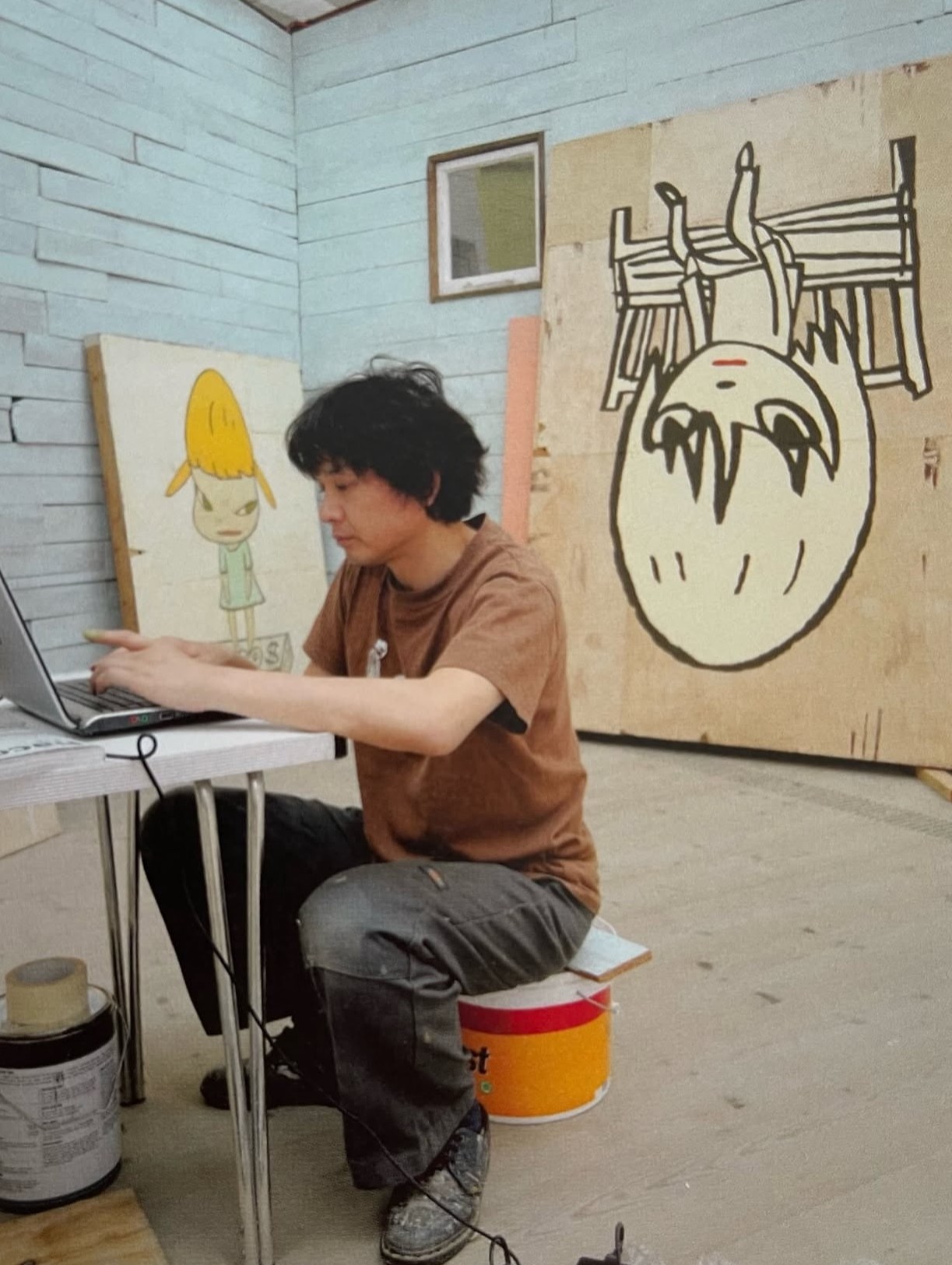
The characters have aged with him in a strange way. Not literally, they’re still children. But the emotional tone has changed. The early paintings can feel louder, more punk, more obviously resistant. Later figures can be extremely still. Some barely seem confrontational at all. They look like they’re thinking.
Nara himself has said that as he changes, the people he paints change too.
In 2025, London’s Hayward Gallery staged the largest European retrospective of his work to date, bringing together more than 150 paintings, drawings, sculptures, ceramics and installations from across four decades.
And he isn’t slowing down. As of 2026, new sculpture is on view at Château La Coste in France, another solo show is scheduled at David Zwirner in New York later this year, and Nara has been announced among the first participating artists for the 2027 Helsinki Biennial.
Which brings us back to the face.
After all the biography, the radio stations, Germany, the earthquake, punk records, protests and multimillion-dollar auctions, the thing people still respond to is basically one child looking at them.
Maybe she’s angry.
Maybe she isn’t.
Nara has spent decades refusing to answer that question for us.
Growing up means learning how to make yourself understandable to other people. You learn how to smile at the right moment, say the right thing and behave in a way everyone else recognises.
Nara’s kids haven’t learned that yet.
And maybe they know something we forgot.
That’s probably the reason why we’re still looking.
ART / YOSHITOMO NARA
Article Tags
Yoshitomo Nara, Art, Contemporary Art, Japanese Art, Culture, Music, Artist Profile
Continue Reading
The Glow After Letter
A thoughtful dispatch, once a week.